
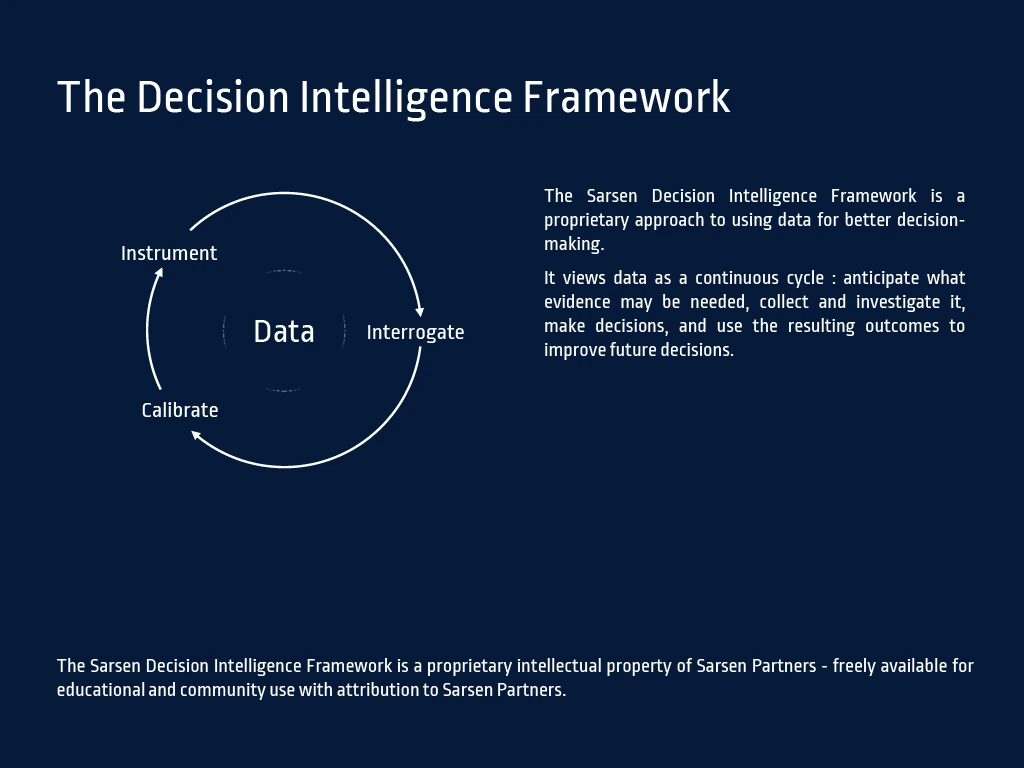
In modern business, data has become synonymous with better decision making.
Companies invest heavily in dashboards, analytics platforms, customer research, financial models, and artificial intelligence. Leaders increasingly ask for more data before making important decisions. The underlying assumption is straightforward: if the decision is supported by enough data, the decision is more likely to be right.
The assumption is only partly correct.
Data can tell us what happened. It can help us understand what is happening. But without context, it can rarely tell us what should happen next.
The same number can represent growth or decline, strength or weakness, opportunity or risk, depending on the circumstances surrounding it.
A business reporting 30% revenue growth may appear to be performing exceptionally well. But what if the market grew by 60%? A company increasing its customer acquisition spending by 40% may appear inefficient. But what if customer lifetime value increased by 100% during the same period?
The data has not changed.
The interpretation has.
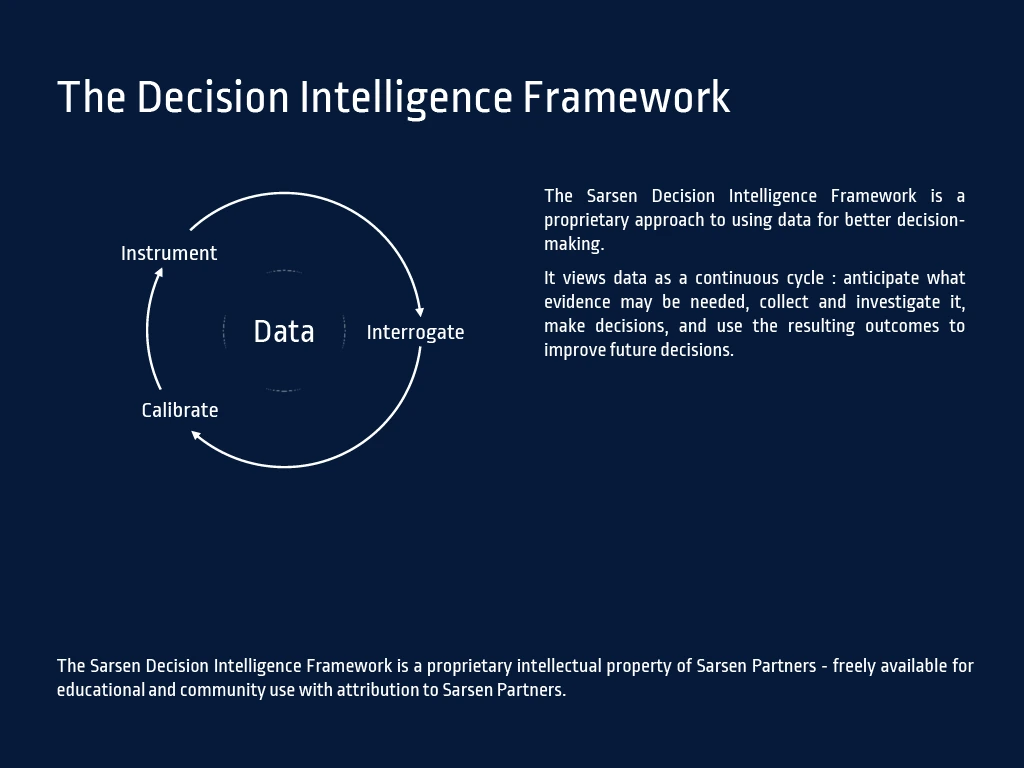
This is why effective strategic decision making requires two things: reliable data and a rigorous understanding of the context surrounding that data.
Data Provides Evidence. Context Provides Meaning.
Consider a company whose sales have declined by 15% over the past six months.
The immediate response may be to identify the cause of the decline.
Has the sales team become less productive?
Has pricing become uncompetitive?
Has marketing generated fewer qualified leads?
Has customer demand weakened?
The temptation is to search the data until a correlation appears.
But correlation alone does not establish causation.
Suppose the company discovers that website traffic has declined by 20% during the same period. It may conclude that lower traffic caused the decline in sales.
That conclusion may be correct.
Or it may not.
Perhaps the company deliberately reduced low-quality advertising traffic after discovering that it generated almost no conversions. Website traffic declined, but the quality of the remaining traffic improved.
Without understanding the business decision behind the number, the data can lead management toward the wrong conclusion.
Context is what connects an observation to reality.
It includes the circumstances, incentives, market conditions, customer behavior, competitive environment, timing, historical decisions, and operational realities surrounding the data.
Without those factors, a number is simply a measurement.
The Same Data Can Support Different Decisions
Imagine two companies reporting the same metric:
Customer retention: 70%
At first glance, both companies appear to have the same problem.
But now consider the context.
Company A operates in an industry where the average retention rate is 55%.
Company B operates in an industry where the average retention rate is 90%.
The same 70% retention rate means two very different things.
For Company A, retention may be a competitive advantage.
For Company B, it may be a significant strategic weakness.
This illustrates an important principle:
A metric rarely has meaning in isolation. Its meaning emerges through comparison.
Comparison may be against the company's own historical performance, competitors, industry benchmarks, customer expectations, strategic objectives, or available alternatives.
The question is therefore not simply:
“What does the data say?”
The better question is:
“What does the data mean in this context?”
Context Changes the Question Before It Changes the Answer
One of the most common weaknesses in business decision making is starting with a dataset instead of starting with a decision.
Executives often ask:
“Why are sales declining?”
“Why are customers leaving?”
“Why has profitability fallen?”
“Which marketing channel performs best?”
These appear to be analytical questions.
But they are often incomplete strategic questions.
Take declining sales.
The actual question might be:
“Is the decline temporary, structural, or caused by a deliberate strategic trade-off?”
Those three possibilities require very different responses.
A temporary decline may require patience.
A structural decline may require repositioning.
A deliberate trade-off may require no corrective action at all.
The data describing the decline may be identical in each case.
The decision is different because the context is different.
This is why strategy begins before analysis.
The first task is not to collect more data. It is to define the decision that the data is supposed to inform.
More Data Does Not Necessarily Produce Better Decisions
There is a persistent belief that uncertainty can be eliminated by collecting more information.
Sometimes it can.
Often, it cannot.
A company can have millions of customer records and still misunderstand why customers buy.
It can have years of financial statements and still misunderstand the economics of its business.
It can track hundreds of performance indicators and still focus on the wrong problem.
The issue is not always insufficient data.
It may be mis-specified data.
If management is asking the wrong question, collecting more data can simply produce a more sophisticated answer to the wrong question.
This creates a dangerous form of analytical confidence.
The dashboards look precise.
The charts look convincing.
The statistical models look sophisticated.
But the underlying decision framework may still be wrong.
Precision in measurement cannot compensate for ambiguity in the problem being solved.
Data Without Context Can Create False Confidence
Numbers often appear more objective than qualitative information.
That creates an understandable bias toward quantitative evidence.
A statement such as “customer satisfaction has declined” feels weaker than “customer satisfaction declined by 8.4%.”
But the second statement is not necessarily more useful.
An 8.4% decline may be statistically significant but strategically irrelevant.
Alternatively, a 1% decline may represent the early signal of a major structural change.
The importance of a number depends on what lies behind it.
Consider a startup whose monthly revenue has increased from ₹10 lakh to ₹15 lakh.
That is a 50% increase.
But there are several possible explanations:
The company acquired a large number of new customers.
A few large customers generated most of the increase.
Prices increased.
Existing customers purchased more frequently.
A temporary market event created abnormal demand.
Revenue was pulled forward from future periods.
The company entered a new segment with fundamentally different economics.
The number is the same.
The strategic implications are not.
A good analyst therefore does not stop at the metric.
They investigate the mechanism that produced the metric.
Context Exists at Multiple Levels
Strategic context is rarely a single variable. It operates across several layers.
1. Historical Context
What happened before?
A sudden change may look significant until it is compared with historical patterns.
A company experiencing a 30% decline in December may appear to have a serious problem. But if December revenue has declined every year because of seasonality, the interpretation changes.
Historical data creates the baseline against which current performance should be understood.
2. Competitive Context
How are alternatives performing?
A company's growth rate cannot be evaluated independently from the market.
Growing 10% in a market growing 2% is very different from growing 10% in a market growing 40%.
Absolute performance matters.
Relative performance often matters more.
3. Customer Context
What is happening in customer behavior?
A decline in conversion may not indicate weaker demand.
Customers may have changed how they research, compare, purchase, or evaluate products.
Understanding customer behavior often requires qualitative evidence that conventional performance data cannot provide.
4. Economic Context
What incentives and economics are driving the behavior?
A business may increase revenue while destroying contribution margin.
A salesperson may increase bookings while generating poor-quality customers because compensation rewards volume rather than profitability.
Metrics are shaped by incentives.
If incentives are misunderstood, the data can be misread.
5. Strategic Context
What is the organization trying to accomplish?
The same action can be good or bad depending on the strategy.
A company deliberately reducing low-margin customers may report lower revenue and higher profitability.
If management evaluates performance only through revenue growth, it may conclude that the strategy is failing.
The metric is accurate.
The interpretation is not.